
 Image 1 of 1
Optional Bases
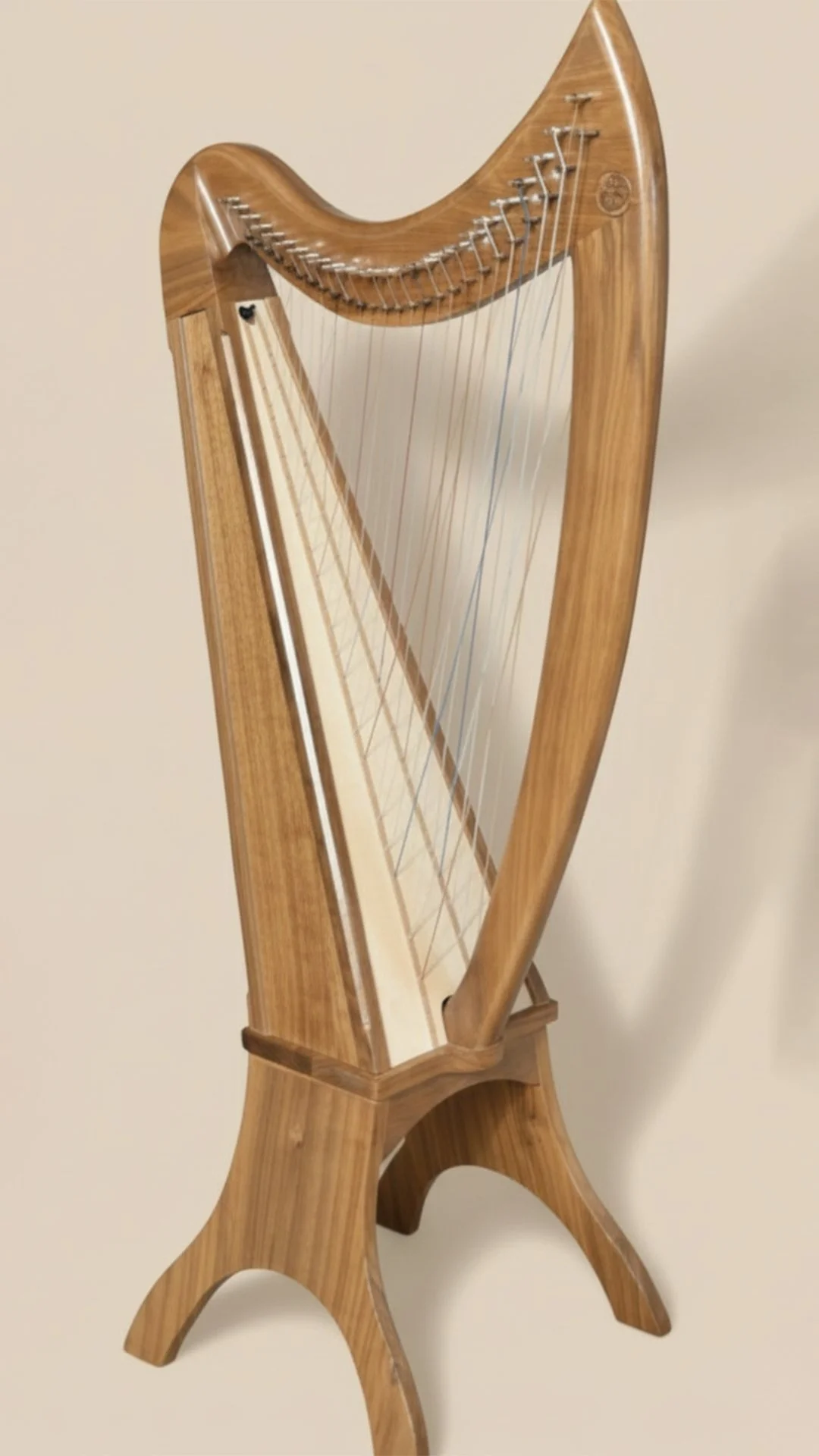
Choose a base to suit your height and playing comfort.
Available base sizes: 15″, 17″, 19″, and 21″.
Recommended Base Height:
Under 5’0” → 15″ base
5’0”–5’4” → 17″ base
5’5”–5’8” → 19″ base
Over 5’8” → 21″ base
Custom Base Height also available upon request.
FREQUENTLY ASKED QUESTIONS
-
Answer: A cross-strung harp features two intersecting rows of strings that cross over each other, allowing you to play every note in the chromatic scale without using sharpening levers or retuning. Think of it like having a complete piano keyboard at your fingertips—one row provides the natural notes (like white keys), while the other provides sharps and flats (like black keys). Your left and right hands can play from either row, giving you seamless access to all twelve notes in any octave. This design eliminates the pauses needed to flip levers on traditional lever harps, making chromatic passages, jazz harmonies, and frequent key changes smooth and intuitive.
-
Answer: The 5/7 configuration follows the traditional piano-like pattern: one row has 7 strings (the natural notes: C-D-E-F-G-A-B), while the intersecting row has 5 strings (the sharps/flats: C#-D#-F#-G#-A#). This layout feels familiar if you think in terms of standard Western music theory and makes it easy to visualize scales and chords.
The 6/6 configuration offers evenly spaced strings with each row containing 6 strings, creating uniform half-step intervals throughout. This symmetrical layout is ideal for players exploring non-Western tunings, microtonal scales, atonal music, or experimental styles where traditional major/minor relationships don't apply. It's also favored by some jazz and contemporary improvisers who prefer the geometric consistency.
Choose 5/7 for traditional chromatic playing in Western music styles, or 6/6 for experimental, world music, or non-traditional approaches.
-
Answer: The cross-strung design does have a learning curve, even for experienced harpists transitioning from lever harps. You'll need to develop hand coordination to navigate two intersecting planes of strings, and the narrower string spacing (1/2″–5/8″) requires more precision. However, many players find that once they adjust to the layout, the Esabelle actually simplifies chromatic playing—no more stopping to flip levers or mentally calculating lever positions.
Beginners: If you're brand new to harp, starting on a traditional lever harp like the Brittany 22 or Braunwen 29 is generally recommended to build foundational technique first. That said, motivated beginners with piano experience or those specifically drawn to jazz, experimental, or chromatic music can successfully start on the Esabelle with proper instruction.
Experienced players: If you already play lever or pedal harp, expect 2-3 months to feel comfortable with the cross-strung layout, and 6-12 months to develop fluency. Most players find the investment worthwhile for the musical freedom it provides.