
 Image 1 of 1
Base Height Recommendations
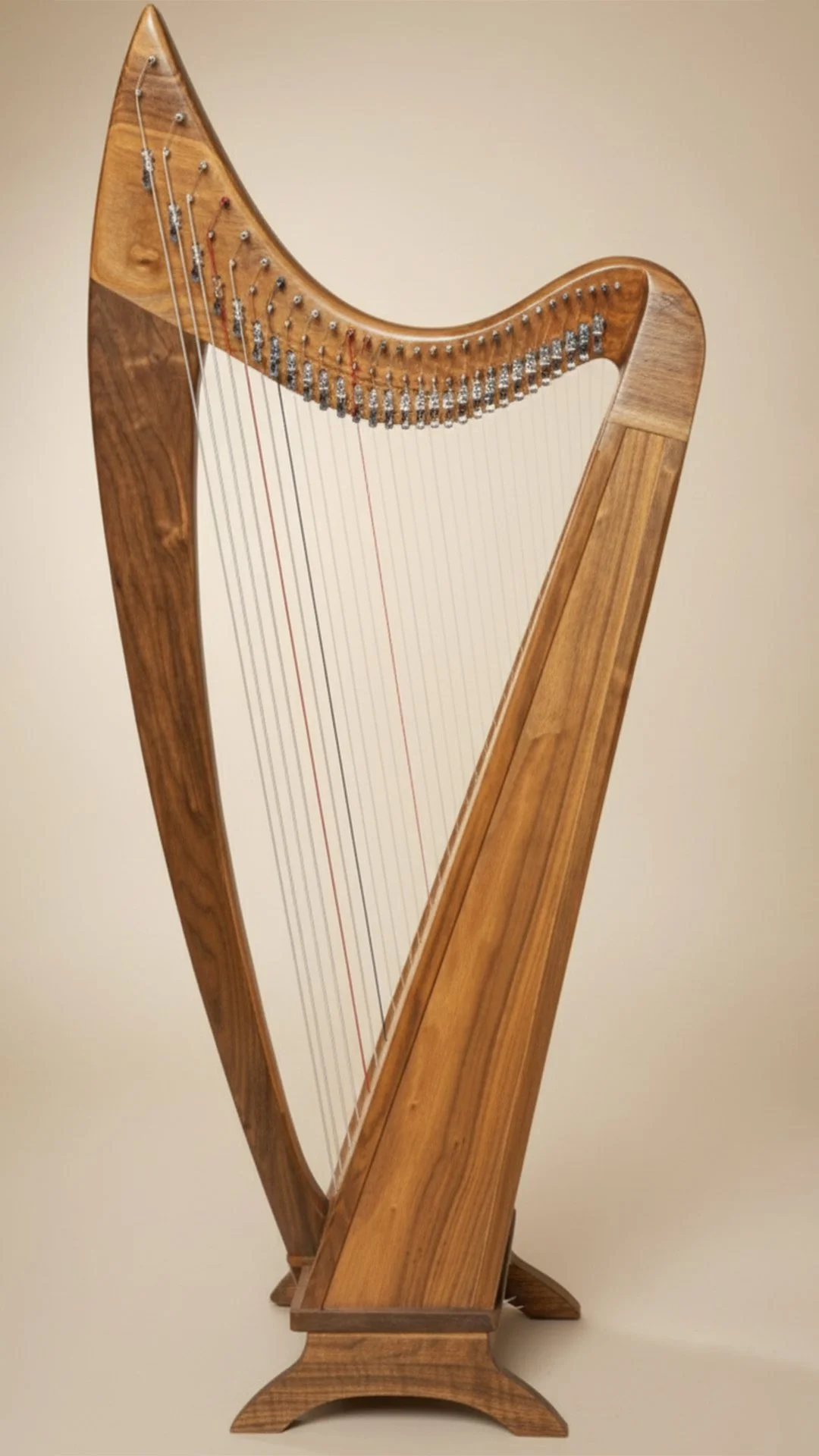
The Lorraine comes with your choice of base, included with the harp.
Recommended base height for comfortable playing posture:
Under 5’1″: 4″
5’1″–5’6″: 6″
5’6″–6′: 8″
Over 6′: 10″
Custom Base Height also available upon request.
FREQUENTLY ASKED QUESTIONS
-
Answer: The Lorraine 29 is an excellent choice for serious beginners who are committed to the harp long-term. Here's why:
Beginner-friendly features:
Low string tension makes it much easier on developing fingers than standard harps—you won't struggle with sore fingertips
Four full octaves (G–G) means you won't outgrow it—most beginner through advanced Celtic and folk pieces fit within this range
Comfortable string spacing (standard 7/16″–1/2″) is easy to navigate for new players
17 lbs weight is manageable but substantial enough to feel stable while learning
Investment considerations:
At 29 strings, you're investing in an instrument that will serve you for decades
The low tension specifically helps beginners avoid bad habits caused by fighting high-tension strings
Many harp teachers recommend starting with at least 26–29 strings to avoid needing to upgrade within 1–2 years
If you're truly a beginner: Consider whether you're committed to regular practice. If yes, the Lorraine 29 is perfect. If you're still exploring whether harp is right for you, you might start with a smaller 22-string lap harp or rent before purchasing.
-
Answer: The low string tension on the Lorraine 29 is a game-changer for many players. Here's what it means in practical terms:
Playing experience:
Less finger fatigue: You can practice 2–3 hours without the hand cramping common on high-tension harps
Gentler on joints: Ideal for players with arthritis, carpal tunnel, or hand injuries
Easier lever engagement: Levers flip smoothly without requiring significant thumb pressure
Better for rapid ornamentation: Celtic rolls, triplets, and grace notes flow more naturally with less resistance
Sound quality:
Tone is NOT compromised: The Lorraine produces warm, resonant sound despite lower tension
Authentic Celtic voice: Many traditional Irish harps historically used lower tension
Excellent volume: Fills a room beautifully—the soundbox design compensates for the lower tension
Who benefits most:
Harp therapists playing 4–8 hours daily
Celtic musicians performing long festival sets
Players with hand sensitivity or injury history
Anyone who's experienced finger pain on standard harps
Beginners building proper technique without strain
Trade-off: Very aggressive, forceful playing styles might prefer higher tension, but 95% of Celtic and folk players find the Lorraine's tension perfect.
-
Answer: Choosing the correct base height is crucial for proper playing posture. Follow these guidelines:
Base height recommendations:
Under 5'1″: 4″ base (special order)
5'1″–5'6″: 6″ base ← Most common for average-height players
5'6″–6′: 8″ base ← Recommended for taller players
Over 6′: 10″ base ← Essential for proper shoulder/neck alignment
How to test your ideal height:
When seated with the harp in playing position, your forearms should be roughly parallel to the floor
The top of the harp should rest comfortably against your right shoulder without hunching
You should be able to reach the lowest strings without excessive bending
Can you change it later? Yes! If you realize after receiving your harp that you need a different base height, you can order a replacement base. However, it's much easier to get it right the first time. If you're between sizes:
Err on the taller side if you use a lower chair or adjustable stool
Go shorter if you prefer sitting on a standard dining chair (17–18″ seat height)
-
Answer: The Lorraine 29 stands out in the small-to-midsize floor harp market for several specific reasons:
Lorraine 29 advantages:
Low string tension: Most competitors use standard or high tension—the Lorraine's comfort is unique
Weight: At 17 lbs, it's lighter than many 29-string harps (some are 20–25 lbs)
Gothic aesthetics: Elegant curves and classic design appeal to traditional music players
Four full octaves: G–G range covers virtually all Celtic and folk repertoire
Included base: Base is included and sized to your height—some brands charge extra
Handcrafted quality: Each harp is individually built, not mass-produced
When to consider alternatives:
If you need extended bass range: 34-string harps start lower (typically C–C or D–D)
If you prefer modern styling: Some brands offer contemporary designs vs. Gothic
If you want maximum volume: Larger soundboxes on 34+ string harps project slightly more
If budget is primary concern: Smaller 26-string harps cost less
Best value proposition: For Celtic and folk musicians who prioritize comfort, portability, and authentic traditional tone, the Lorraine 29 offers exceptional value. You're getting professional-quality sound without the weight, cost, and hand strain of larger concert harps.
-
Answer: Absolutely yes—the Lorraine 29 is fully professional-grade for Celtic and folk music. Here's why:
Range coverage:
Four octaves (G–G or F–F) covers 100% of traditional Celtic repertoire
Most O'Carolan tunes, Irish session tunes, and Scottish airs fit comfortably within this range
Only orchestral or advanced classical pieces require the extended bass of 34–40 string harps
Professional features:
Low tension is actually preferred by many professional Celtic harpists—it's not a compromise, it's a feature
Lever quality: Camac and Loveland levers are professional-grade, used on harps costing $5,000+
Tone and projection: The Lorraine's soundbox design produces rich, clear tone that carries in performance venues
Recording-ready: Excellent clarity and warmth for studio work
Real-world professional use:
Celtic bands and ensembles regularly use 29-string harps
Harp therapists choose the Lorraine for hospital and hospice performances
Wedding and event harpists perform full 2–3 hour sets comfortably
Festival performers appreciate the portability without sacrificing sound
When you might want larger:
If you're playing orchestral or advanced classical repertoire requiring extended bass range
If you perform in very large venues (500+ seats) without amplification
If your specific arrangements call for notes below the G or F range
Bottom line: For Celtic, folk, hymns, therapeutic music, and 90% of traditional harp repertoire, the Lorraine 29 is absolutely professional quality. Don't let its "compact" size fool you—this is a serious instrument.